

Ask an agent. Get a team.
When we started Airtable twelve years ago, our bet was simple: software should adapt to how people actually work, not the other way around.
That bet paid off. Today, over 500,000 organizations, including 80% of the Fortune 100, use Airtable to build applications that fit their workflows.
Now we're making the same bet on AI agents. And the breakthrough isn't a smarter single agent; it's multiple agents working together.
Today, we’re announcing Superagent, our first standalone product built on multi-agent coordination. When you ask Superagent a question, you're not getting one AI assistant doing sequential tasks. You're getting a coordinating agent that plans the work, deploys specialists who work in parallel, and synthesizes their output into a finished deliverable you can immediately use.
This approach reflects what I call 'inside out' product thinking: start with what's now technically possible at the frontier of technology, then work backward to create the right product experience. Multi-agent systems represent that frontier today.
Superagent is built on our acquisition of DeepSky and reflects our broader momentum in AI – from hiring David Azose as CTO after he led ChatGPT's business products at OpenAI, to launching Airtable for ChatGPT, to refounding as an AI-native platform. It's live now at superagent.com.
The Breakthrough: Teams of Agents, Not One Agent
Here's what's happening under the hood when you use Superagent:
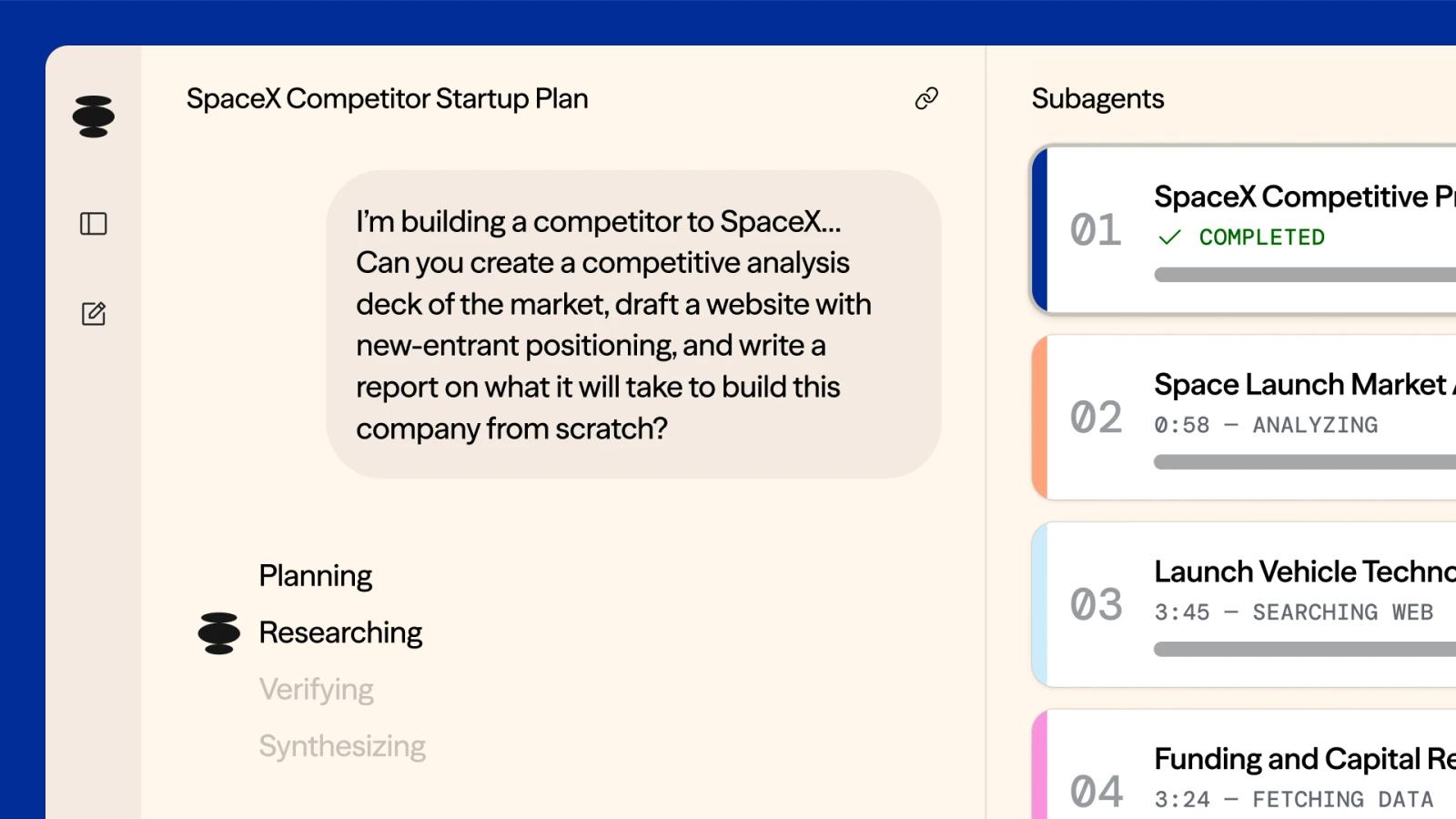
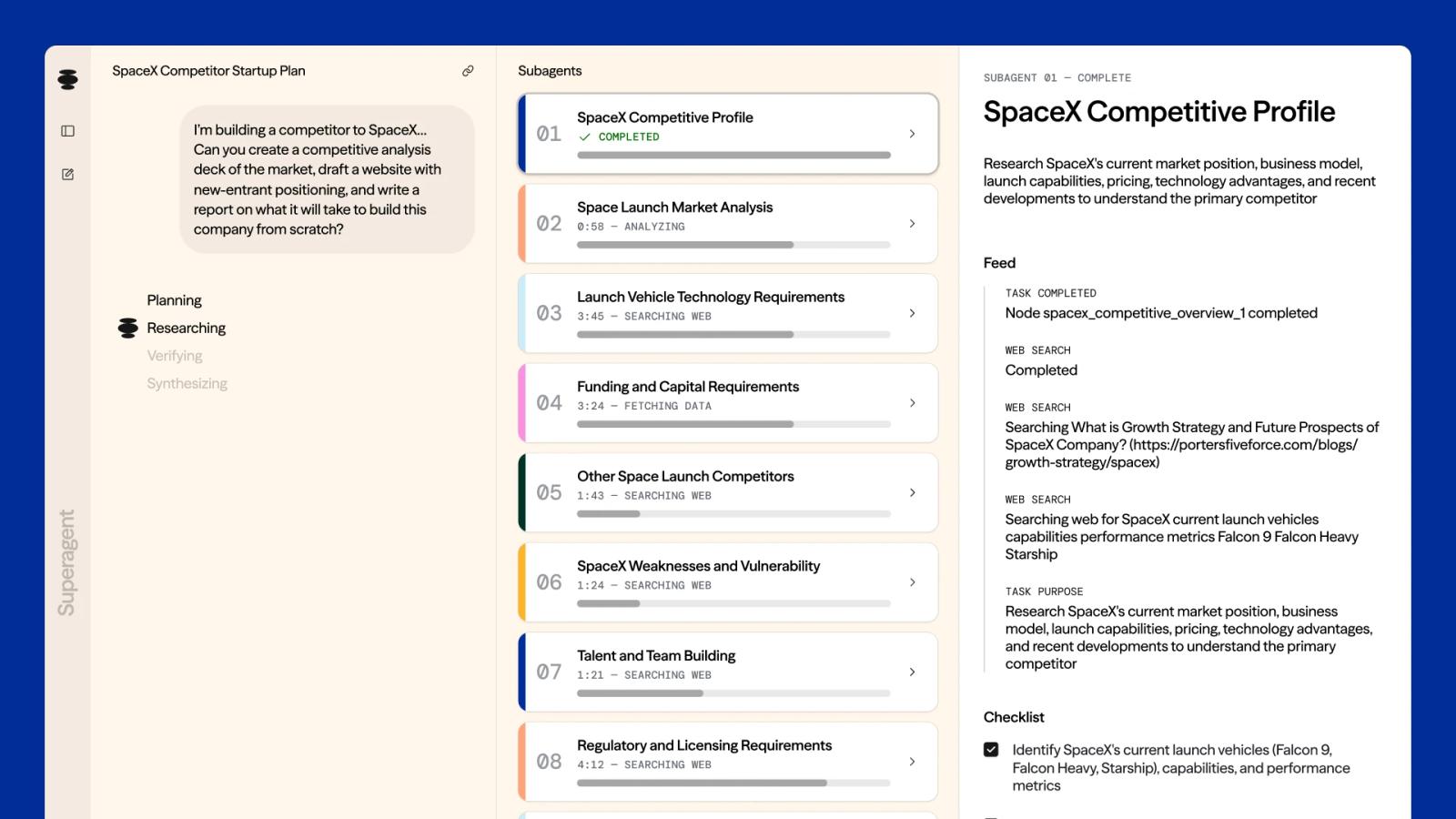
You ask a question, and Superagent doesn't start searching; instead, it immediately builds a research plan, identifying what needs to be investigated, surfacing dimensions you didn't think to ask about, structuring the work like a team of analysts would.
Then it deploys specialized agents. One investigates financials, another analyzes competitive positioning, another reviews management and recent news. These agents work in parallel, their work coordinated by the system, each contributing their piece to the whole.
Finally, it synthesizes. Superagent takes all the parallel work streams and weaves them into a coherent, polished deliverable – not a wall of text, but a rich, interactive artifact, custom-built for your question.
You're not prompting an AI. You're orchestrating a team. That's the difference between asking a traditional chat product to research a competitor and asking Superagent: instead of a sequential summary built by one agent working through tasks one at a time, Superagent deploys a coordinated team to investigate multiple dimensions simultaneously, then delivers an interactive competitive landscape ready to present.
What This Means for Your Work
The power of multi-agent coordination isn't just about speed. It's about getting outputs you can actually use.
Ask where your US-based premium athleisure brand should expand first in Europe. Superagent doesn't give you a text document. You get an interactive market analysis: demographic breakdowns by country, competitive presence mapped visually, expansion timelines you can filter and explore. It's ready to walk into a meeting and present.
Ask it to evaluate Google as a 3-year investment opportunity. You get a structured assessment detailed with citations to earnings calls and filings, defensibility analysis against OpenAI and Anthropic with side-by-side comparisons, and risk factors that you hadn't considered. It's research that informs your investment thesis immediately, not raw material you need to spend hours processing.
Ask it to brief you on Wells Fargo's AI strategy before pitching them on your compliance product. You get their regulatory posture, recent AI investments with deal details, competitive pressures they're facing, and the specific pain points your product addresses. It's pitch prep that's actually ready to use.
What if every task you tackled came with New York Times-quality data visualization? That would have been unfathomable five years ago. With Superagent's multi-agent architecture, it's the default.
The output isn't raw material. It is the deliverable.
That’s what multi-agent coordination unlocks: agents working in parallel produce deeper intelligence faster, and because the system coordinates their work, identifying dependencies, filling gaps, synthesizing insights, the final output is coherent, polished, and ready to ship. You're not reformatting. You're not synthesizing. You're using it.
How We Built It
- Professional-grade sources. Superagent pulls from premium data sources like FactSet, Crunchbase, SEC filings, and earnings transcripts. Insights are verified, cited, and traceable.
- Open-ended agent harness. Unlike older agents that follow rigid, hard-coded paths, Superagent uses a flexible architecture that gives agents autonomy to navigate different approaches, coordinate with each other, backtrack when needed, and adapt to what each specific task requires.
- Outputs designed for humans. Rich, structured deliverables designed for how people actually think and work. Interactive. Visual. Actionable. Instead of a wall of text, you get a rich, immersive artifact with elements like filterable comparison matrices, expandable detail cards, visual positioning maps.
Why This Matters
We've been talking about agents for two years, but what we had even a year ago weren't real agents. They were workflows: predefined series of steps with some LLM calls mixed in.
Now we have true multi-agent systems that can break complex tasks into components, assign specialists, coordinate their work, and deliver finished output. Multi-agent coordination is the defining architecture of today. We’re moving AI from single-threaded chat to parallel, collaborative intelligence.
This isn't an incremental improvement to software. Agents don't just help you work. They do the work.
Twelve years ago, we bet that software should adapt to work, not the other way around. Today, we're betting that AI agents will become critical infrastructure for every organization. The winners won't be the companies with the fastest models, but the companies that deliver multi-agent systems you can actually trust to complete complex work.
The general-purpose, highly usable multi-agent system is becoming a fundamental primitive for knowledge work. And there's a natural complementarity – almost a yin and yang – between the structured data and application layer that Airtable provides and the autonomous, coordinated intelligence that Superagent delivers.
Over the coming months, we'll be deepening Superagent's integration with Airtable and expanding our premium data sources. You'll soon be able to invoke Superagent directly from your Airtable bases, running research across your pipeline, generating insights that flow back into your structured data, and automating intelligence gathering at scale.
Try It Today
Superagent is live at superagent.com. Ask it to tackle a complex question you're wrestling with (a competitor analysis, a market opportunity, a strategic decision) and see what happens when you stop prompting an AI and start orchestrating a team.
Let's keep building.
—Howie Liu
CEO & Co-founder, Airtable
Get the latest Airtable news
Company

Airtable announces David Azose as CTO and the acquisition of DeepSky
Airtable Becomes a Multi-Product, AI-Native Company with the Acquisition of DeepSky and Appointment of David Azose as CTO
Company
Airtable AI users can now access IBM watsonx.ai and IBM Granite Models
Tap into watsonx’s AI capabilities for GenAI-powered applications that can transform your work